YOUR CART
IS EMPTY
IS EMPTY

“Flood” No one wants it to happen, and if it's unavoidable, what should we do? Let's look at recommendations regarding a "car" submerged in water or driving through water.
When driving through water, the first thing to know is “the depth of the water.” Observe easily from a car in front with similar height. If the water level reaches the lower edge of the door, do not proceed, as water can enter the car, even if the engine has not yet stalled (if the water level has not reached the air filter). It is best to change your route. If unavoidable, it is recommended to find plastic or a rubber sheet to cover the front grille of the car to prevent water waves from entering the engine compartment.
If you have assessed that you can drive through, turn off the AC and lower the windows slightly. Because when the AC is on, the AC system's cooling fan will operate, causing the fan blades to possibly spin and splash water all over the engine compartment, especially the electrical system, and into the air filter, which could cause the engine to stall. Also, drive slowly and reduce speed when driving past other cars, as water might cause damage to oncoming vehicles. In manual transmission cars, do not hold down the clutch to keep the engine RPM high, as this will cause clutch slip. Use the lowest gear and maintain a consistent speed.
After driving through (deep) water, damage will quietly follow, leading to unnecessary high costs.The parts directly damaged are steel components, such as the inner steel car chassis (where rust-proofing spray cannot reach), steel car accessories, or even various nuts, because they will rust easily. Over time, they will corrode faster than usual. Additionally, water may enter through deteriorated rubber hoses, such as drive axle boots. When water mixes with grease, internal parts rust, causing them to deteriorate quickly. There is also a chance for water to mix into various lubricants, such as gear oil, differential oil, etc.
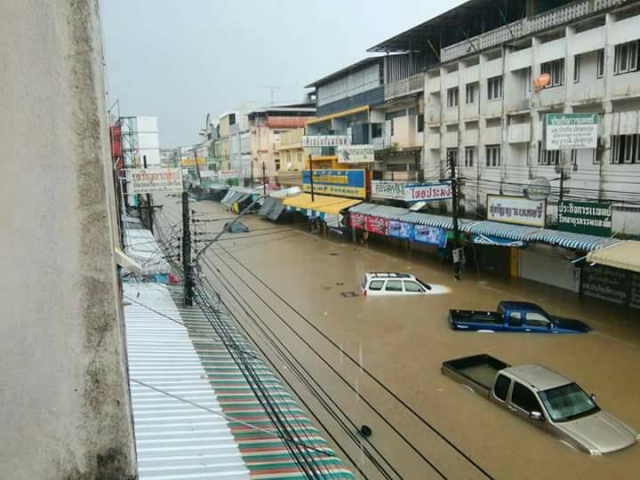
Image source: Amazing Sakon Nakhon
● Absolutely do NOT start the car or turn the key to the ON position! Because the car has electronic and electrical equipment that controls various systems, it can cause a short circuit and damage. The best way
● Immediately disconnect the battery terminals! To cut off the power supply
● Take the car to a garage or service center to change all fluids, such as engine oil, brake fluid, power steering fluid, differential fluid, coolant, etc.
● For the suspension or support system, technicians should re-grease the ball joints and check if the brake system is abnormal, especially for drum brake systems where water may enter; they must be disassembled and cleaned.
●How to claim insurance for flood-damaged cars > How much can flood insurance cover?
1. After driving through water, press the brake repeatedly to squeeze water out of the brake discs.
2. Spray water thoroughly to wash the undercarriage. Use a soft-bristled brush to scrub off mud, debris, or small branches.
3. Open the car hood to inspect for flood damage and blow air to remove water.
*4. Check the engine oil to see if it is at a normal level, as water may have mixed in.
*5. Check all fluids, such as transmission fluid and power steering fluid, to see if water has mixed in.
6. If water has reached the fuse box, remove the fuses, wipe them, and blow them dry.
7. Blow air to remove water from electrical terminals and the battery.
8. Spray moisture repellent on the battery terminals.
9. Spray moisture repellent on various electrical terminals.
10. Remove the floor mats. If they are wet, clean them and dry them in the sun.
(Steps 4-5: If water is mixed in, you should have them changed at a service center immediately)
Source
Article: autoinfo.co.th/ Car Check
Image: Amazing Sakon Nakhon
Read more: How to drive safely in the rainy season


Follow Motor Expo Club Network